
Office lighting fixtures — not just bulbs — are one of the highest-impact investments in office interior design, shaping how employees feel and how clients perceive a space. Robin Pasley explains why the standard drop-ceiling troffer is only one layer of a lighting strategy, and how adding pendants, wall sconces, and accent lighting creates comfort, elevates brand presence, and lifts the entire feel of a workspace. Business owners who address lighting first will see the greatest return on any design investment.
[Randi Lynn Johnson]: So we've talked about lighting — bulbs, Kelvin, CRI, all of that. But there's another piece of lighting, and that is fixtures — how things are positioned against the wall, how they emit light, and how all of that can really affect a space.
[Robin Pasley]: Yes. Most offices, in a town like ours here in Colorado Springs, have a drop ceiling, and inside that drop ceiling there are either two-by-four or two-by-two light fixtures that we call troffers. That's standard fare. There's a couple of things to keep in mind: if you have fluorescent fixtures in there — and if you've been updated anytime soon, you had to move to LED office lighting for code anyway — fluorescents have gases in them and can give people migraines, because they have a cycle that your eye picks up. Your brain is registering it even if your eyes don't consciously see it. So I'd suggest replacing those with LED tubes if your ballast and fixture will allow it. That's one way to update that piece. But there's another way to think about lighting for comfort and space usage, and that's to approach it in layers.
[Robin Pasley]: The three layers I think about — and I'm not a lighting designer, so this is a shallow overview — are general lighting, task lighting, and accent lighting. Accent lighting relates more to featured spaces and fixtures that aren't just in the drop ceiling — whether it's a pendant, a wall sconce, or something similar. If you approach lighting from a layered point of view, you can bring more interest to a space and elevate its comfort. To me, lighting is 80% of a design. If you were going to ask what you could spend your money on for the greatest impact on your space, lighting is one of the first things I want to talk about.
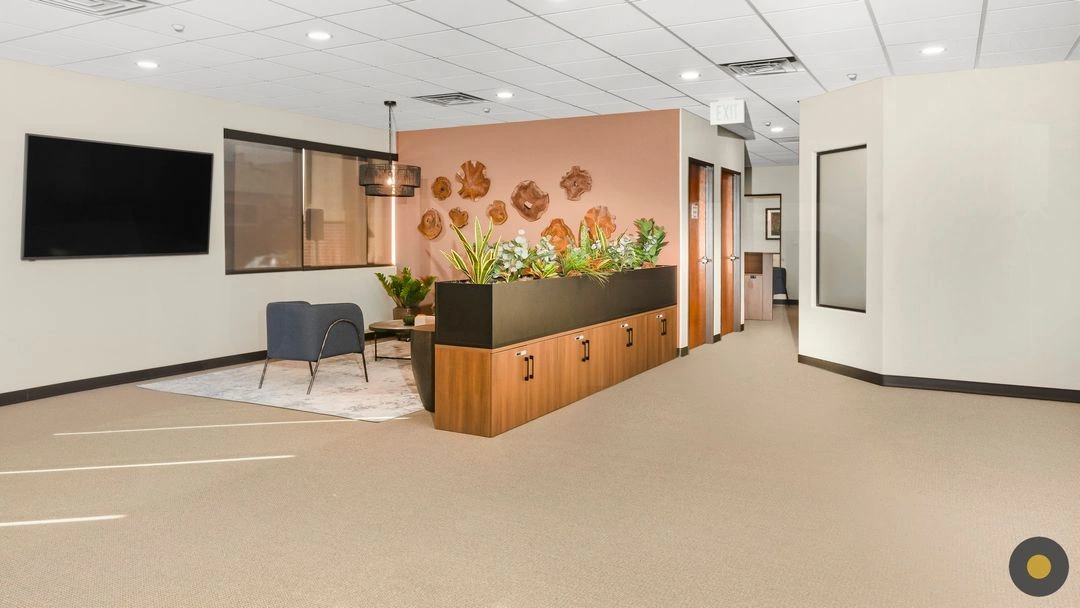
If we're working with a standard drop ceiling and a troffer, that's as basic as you can get — pure function. But we could accentuate the focal point behind your reception desk with a specialty set of pendants, or put focus lights on a wall that tells your company's history. That's what I mean by layers — more than one way to emit light into a space, whether to draw focus to something or add design flavor. Pendant fixtures and wall sconces are exactly that kind of flavor. Have you ever walked into a place and your first impression was, "Oh my gosh, this feels amazing"? I would put all my money on the fact that the space was just really well lit and used a layered approach to commercial interior design.
[Robin Pasley]: If you've walked into your own office and haven't thought, "This feels amazing," then lighting is probably the first thing to address. I've worked with a couple of businesses whose workforce was mostly coding — working at a computer all day watching code come down a page. The first day I walked through one of those sites, all the lights were off. I thought everyone was working from home; this was around 2021 or 2022. I said, "Oh, they must all be working from home." The owner said, "No, they're here." I said, "What is happening?" She told me they couldn't stand the lighting.
[Robin Pasley]: That was one of the first things we addressed: for your function, you're already aware that this troffer lighting in this drop ceiling is not serving your workforce. That's worth thinking about. How do we keep our best employees happy? Think about lighting, and ask them: how does that lighting make you feel? How do you feel when you're working in your office?
[Robin Pasley]: There's also the issue of shadow. A small office that only has one or two troffers — which may be all that's required for that electrical engineer to bring the room to code — can create a shadow around the whole perimeter. That makes the space feel like a cave. Now, if you've put any color in there, and the value of that color from a paint standpoint carries a slightly darker number, it's going to feel even more cave-like. Then you're stuck with white walls and two troffers, and that's about as basic as it gets. All it would take to change everything is adjusting the lighting — and the space would feel completely different.
Recorded in our studio at 616 N. Tejon St., Colorado Springs, Colorado, 80903
PASLEY COMMERCIAL INTERIORS is Colorado's trusted partner for growth-focused commercial interior design. As a woman-owned, NCIDQ-certified firm based in Colorado Springs, we blend spatial branding, client experience design, and turnkey interior solutions that help businesses make powerful first impressions and win their ideal clients. Our direct-to-manufacturer dealership simplifies the commercial furniture procurement process — reducing costs, cutting lead times, and delivering measurable ROI for every client. With deep expertise in workspace strategy, branded environment design, and commercial space planning, we transform business identities into client-converting spaces that inspire loyalty and drive revenue. From boutique and medical aesthetics buildouts to hospitality, multi-family, and franchise commercial projects, PASLEY COMMERCIAL INTERIORS delivers both impactful aesthetics and bottom-line results — because your space should work as hard as you do.
H.B. Pasley, Branding & Business Growth Advisor
616 N Tejon St
Colorado Springs, CO 80903
To request our complete Press Kit, call or schedule a conversation via our Contact Page.




.avif)
