
Building a trust-based business interior design firm requires more than great design work — it demands a deliberate strategy for nurturing the clients you already have. In this episode, growth advocate HB Pasley and client experience officer Randi Lynn Johnson reveal how Pasley Commercial Interiors turns happy clients into active advocates through empathy mapping, CRM automation, and personal relationship-building. Business owners who apply these tools will generate more referrals, more reviews, and clients who know exactly how to recommend them.
Find HB at www.hbpasley.com and his book here: https://a.co/d/cJWza82
[Robin Pasley]: Welcome back. This is part three of the Growth Advocate Meets Pasley Commercial Interiors interview. You are our guest, HB Pasley.
[HB Pasley]: Thank you for stating the blindingly obvious. That is true. I love it that you're you. I've been listening to your podcasts — they're very informative. Thanks for doing that. It's all about commercial interior design. Some of them are nerdy, some of them are a little more where I can follow along. You've been interviewed by Randi Lynn, who's with us now. I don't know if the listeners can hear her breathing, but she's at the table. She is our client experience officer.
[HB Pasley]: Randi Lynn, how would you describe your role in the firm? If you were going to self-define — what does it mean to be the client experience officer for Pasley Commercial Interiors?
[Randi Lynn Johnson]: To jump back to episode one, where we talked about why you do what you do, not just what you do — I'd start with a story of how I grew up feeling very celebrated, always making things a big deal, and helping people feel championed. I get to do that for our firm. I get to check in with our clients, celebrate their successes even apart from us. It's like, "Hey, we opened a new location" or "We had our highest-grossing quarter ever" — just getting to champion them. And in a practical sense, celebrating projects wrapping, checking in with them during the process, asking how they feel everything's going.
[HB Pasley]: That's really exciting — and really caring for people.
[Randi Lynn Johnson]: That's what it comes down to. It is a human element.
[HB Pasley]: I think often firms who do technical things — like commercial interior designers — make the mistake of thinking that their skill and the outcome itself is all that a client needs to be happy. We all need somebody to put their hand on our shoulder, offer encouragement, and just ask how we're doing through the process — especially when a project takes not weeks but months and months.
[Robin Pasley]: Or years. We've got projects that take two or three years to get finished.
[HB Pasley]: Taking care of the people we love is, in some ways, more fun than the technical work we do. The people we love are really the center of our universe. I was congratulating you. We looped all the way around to say it's great to hear you talk about your business. Now I'm the first of many interviews to come. You've got architects, designers, CPAs, all kinds of different business people in town and clients you're going to interview on your podcast. I was lucky enough to be the inaugural interviewee.
[Robin Pasley]: I thought it was appropriate, since you've been with us all year.
[HB Pasley]: And I've been with you for 30 years.
[Robin Pasley]: You've been with me for 30 years, but you've been embedded as a fractional COO since January of this year.
[HB Pasley]: I take all those letters and I jumble them around and I spell anything I want.
[Robin Pasley]: I don't really think you should do that.
[HB Pasley]: Never mind. Okay — client experience. This is the third element of the work I do as a growth advocate. As a business advisor, I often join teams in a fractional way — as a part-time member of the executive team. We work on strategy, leadership skills, and systems. And sometimes we work on how to build your firm — not just on strangers learning about you, but on the strength of the advocacy of your favorite clients. That's what I call growth from the center.
[HB Pasley]: When I talk about this, I often show a picture of a tree — there are leaves and a trunk. You can see it's a classic spring tree. Which part of the tree is most exciting? Which has the most color? People always celebrate the leaves.
[HB Pasley]: And that's where marketing people spend most of their time — the leaves. How to get new clients, how to attract new clients, how to spend money on the latest social media program. It's all valuable, and you've got to have those people, but they rarely think about the trunk of the tree. I haven't met a marketing agency recently that focuses on cultivating the advocacy of present clients. Why? Because that takes more work. It takes personal commitment, conversational commitment. The firm has to believe it's important. You have to put money and time into it. You have to hire — wait for it — Randi Lynn, a client experience officer.
[HB Pasley]: Your role is to personally, hand-to-hand, cultivate relationships with clients. Why? Because we want them to be happy. We love them. And we know that happy clients will refer. They will introduce, they will advocate for us in the marketplace. A lot of firms need this because without advocacy they can't develop enough trust — and we're doing big, expensive, remarkable things. You do big, expensive, remarkable things here at Pasley Commercial Interiors.
[Robin Pasley]: We do.
[HB Pasley]: I don't mind saying the word expensive, because renovating an office or building a multi-story building is not like buying a new pair of shoes. You're going to be spending a significant amount of money. I like that we've been working on how to help people make that choice wisely. How do you choose the right architect? How do you choose the right banker? How do you choose the right interior designer? That choice should be based on more than a 10-second glance at a portfolio. You need to know if these people are going to fit on your team. We've spent a meaningful amount of time developing our client experience acumen around here.
[HB Pasley]: Robin, since you've been with me through my whole journey of learning about client experience — five years ago, I didn't know what to call this. What would you say is one of the key elements that has created more success in your business around the client?
[Robin Pasley]: Not thinking like the designer was one of the first things you introduced me to — and I thought it was the game changer in my mindset. I'm always thinking about the things I think are important. When you asked me to get into the client's shoes at every point of the process and think, "What do they need to hear? What do they need to know right now?" — it changed the way we communicated. Everything from note-taking to our internal processes is now based around what the client needs to know at this moment.
[HB Pasley]: I want to touch those steps and help your listeners know exactly how to start doing what we call empathy mapping — thinking like the client through each step of their journey with you. If you're a business owner, here's what you do: take out a piece of paper right now. You can do this with your leadership team, but you can start now. All I want you to do is name the steps your clients go through, from beginning to end.
[Robin Pasley]: From the start of whatever you do with them, until they say goodbye and you've completed your work.
[HB Pasley]: That's correct. Some of you have a client experience that's five minutes long — they come in your store and leave. Some of you have one that's a week. Some, like Robin, it might be 18 months or two years or longer. Some of you have lifetime clients. But it will have stages: the very first time they hear about you, because they have a problem but don't know you exist — that's a step. The first time they get on the phone, visit your website, or receive anything from you — that's a step. The first time they come in, meet with you, and spend an hour in conversation or review documents — that's a step. When you're designing things for them, implementing things, completing things — these are all steps in the process. Write them out on a piece of paper in a line, then step back and say, "Okay, that's everything my team does to get this done."
[HB Pasley]: You might have five steps. You might have 20. Next — this might take a cup of coffee — you're going to do what Robin just described. Go into each step. Put the client's shoes on your feet and turn the other way in your mind. Pretend you're the client.
[HB Pasley]: Ask yourself: How am I feeling at this stage? What am I struggling with? What questions do I have? What concerns me? What's the big thing I must resolve at this step? You make a mistake if you think clients come to you to solve one thing and keep that top of mind all the way through. At each phase they ask different questions: Did I make a good choice? Are they going to treat me like the last firm did? How will this next step go? How long will this take? Map those questions across each step. That's your phase one for building what I call empathy mapping — and your team's collective empathetic IQ.
[HB Pasley]: People call this emotional intelligence, or EQ. But this is more specific — it's about thinking like your client at each distinct stage. Once you've mapped it, you're on a journey to decide how you'll answer those questions and build those responses into your systems. Robin, you mentioned earlier that you went into your CRM and created an automation that reminded team members to reach out to clients at specific intervals during the construction phase. You made it so the system tells you to act in response to the empathetic map you made. You're living it out. I think this is critically important. And as you know, I may have written a book about it.
[Robin Pasley]: I was just going to say — we have to tell them about your book before we end today. We'll have Randi put the link in the podcast episode. It's called Never Drop the Ball Again.
[HB Pasley]: You can find it on Amazon — just search Never Drop the Ball Again by HB Pasley. I love it because it's short and I'm dyslexic, so reading can be a chore. Tiny hardback, 100 pages, large print. Look at the diagrams. I laid out eight steps of client experience — eight foundational steps for any trust-based business — so you and your team can see how a client feels through the entire process. Instead of just talking about it, you can put it into your systems and start delivering better responses. I'd wager you won't even have to do more — you'll just add intelligence to what you're already doing. That's good news for the business owner.
[Randi Lynn Johnson]: Right.
[HB Pasley]: The outcomes will be more referrals, clients more willing to write reviews online, clients who want to engage with your social media and attend the events you're hosting.
[Robin Pasley]: I think one of the biggest things was clients who knew how to refer me now.
[HB Pasley]: Not just that they wanted to — but they knew exactly how to do it.
[Robin Pasley]: Right. Because over the course of the journey we went through together, I helped them understand more clearly what Pasley Commercial Interiors does for businesses — so they knew how I could be that for someone else they're friends with or other business owners they know.
[HB Pasley]: It's been great. It's cool to get to share a little about my work, because I've been able to work with you, but I do my own thing out in the world with different kinds of businesses — financial advisors, commercial real estate developers, people in medicine and healthcare, people in design. Anyone who builds trust in order to do what they do. I've enjoyed helping them grow, and I appreciate the opportunity to come and talk about it.
[Robin Pasley]: People can come to our website to see your face, but if they want to learn more about this part of what you do, where would they go?
[HB Pasley]: HBPasley.com. H — B — P as in Paul — A — S as in Sam — L — E — Y.
[Robin Pasley]: We just talk over each other simultaneously.
[HB Pasley]: HB as in Honey Biscuit — Pasley. No more fill-in-the-blank games. You've got it.
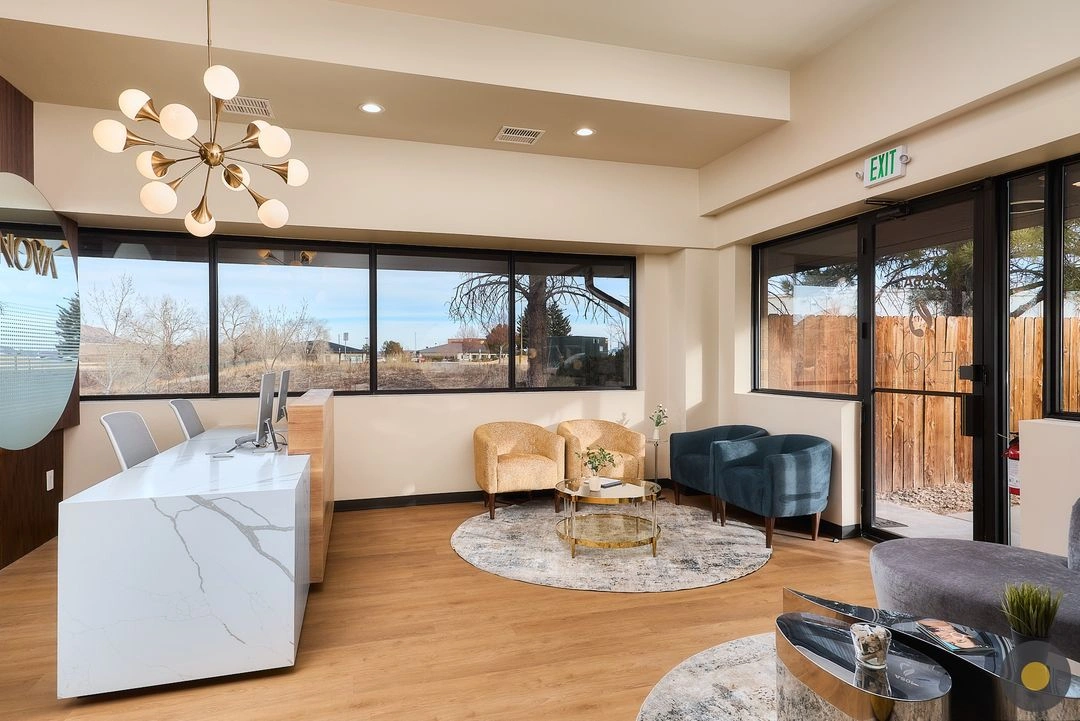
PASLEY COMMERCIAL INTERIORS is Colorado's trusted partner for growth-focused commercial interior design. As a woman-owned, NCIDQ-certified firm based in Colorado Springs, we blend spatial branding, client experience design, and turnkey interior solutions that help businesses make powerful first impressions and win their ideal clients. Our direct-to-manufacturer dealership simplifies the commercial furniture procurement process — reducing costs, cutting lead times, and delivering measurable ROI for every client. With deep expertise in workspace strategy, branded environment design, and commercial space planning, we transform business identities into client-converting spaces that inspire loyalty and drive revenue. From boutique and medical aesthetics buildouts to hospitality, multi-family, and franchise commercial projects, PASLEY COMMERCIAL INTERIORS delivers both impactful aesthetics and bottom-line results — because your space should work as hard as you do.
H.B. Pasley, Branding & Business Growth Advisor
616 N Tejon St
Colorado Springs, CO 80903
To request our complete Press Kit, call or schedule a conversation via our Contact Page.




.avif)
