
Biophilic design — the practice of integrating nature into built environments — is one of the most evidence-backed tools a commercial interior designer can apply to improve how people feel and perform in a space. Robin Pasley explains how nature elements, from living walls to faux plant life and organic textures, trigger measurable psychological and cognitive benefits including stress reduction, a 14% improvement in short-term memory, and increased creativity. Business owners who understand these principles can make smarter design investments that support employee well-being, client experience, and long-term brand impact.
[Randi Lynn Johnson]: So, Robin, over the past few episodes we've talked about ergonomic furniture, the psychology of color and lighting, but today I wanted to unpack using plant life in design and the benefits of it.
[Robin Pasley]: Awesome. One of my favorite topics.
[Randi Lynn Johnson]: Biophilia is the actual phrase. Biophilia.
[Robin Pasley]: It's such a fun word.
[Randi Lynn Johnson]: Here's a little water cooler trivia for our listeners. Biophilia is the idea that humans have an innate tendency to connect with nature and other living things. The term comes from the Greek words bio and philia, which literally translates to love of life.
[Robin Pasley]: I like that. I mean, I probably could have thought about it long enough and put it together, but I'd never done that before.
[Randi Lynn Johnson]: I always thought green, but it means love of life. Harvard naturalist Dr. Edward O. Wilson coined the term in his 1984 book Biophilia to describe the rich natural pleasure that comes from being surrounded by living organisms. So you can casually drop that the next time you're in a space that's using biophilia — or use it to convince your spouse to let you buy a new plant.
[Robin Pasley]: I guess it probably has to do with why they say that putting a fish tank lowers your blood pressure and brings calm, because it's a life form that is contained. When the fish are in there, it makes me feel good because there's a life form over there doing its thing.
[Robin Pasley]: I've often talked to clients about this, because I find some pushback when I want to use biophilia in a project — and I use it in almost every project — simply because it is our human connection with life. When you think about a movie where they're going to Mars or another planet, what are they looking for? They're looking for plant life because it tells us we can survive there.
[Randi Lynn Johnson]: We'll be okay.
[Robin Pasley]: Exactly. And I think it's the same way when we see plant life in a space — or some other form of natural life, even water or fish — it tells us that I'm going to be okay here. It actually registers in our biometrics in ways we're largely unaware of, but you know when it's missing. We could do a remarkable commercial interior design with all these great textures, colors, and lighting, but without plant life or something that reminds us of nature, it will feel stale and sterile.
[Randi Lynn Johnson]: There are actually studies that show how biophilia can help with mood. Would you mention some of those?
[Robin Pasley]: The psychological effects are significant. Biophilic environments have a restorative effect that reduces stress and anxiety. Putting these elements in educational spaces — where those stresses and anxieties run high — is especially important. Think about hospitals, where stresses run high; people recover faster in those environments.
There's also been a study finding that biophilic environments can improve short-term memory by up to 14%. Having those elements in senior living facilities and memory care environments makes a real difference. We've done projects that are trauma-informed design spaces, and biophilia in those is a must — not an option — because we need to bring down the anxiety levels. Biophilic design has also been proven to increase creativity by impacting cognitive function and elevating mood, which helps people access the more creative part of their brain. Studies have also shown decreased symptoms of depression and ADHD.
[Randi Lynn Johnson]: All good things — especially in those education environments.
[Robin Pasley]: It's really great.
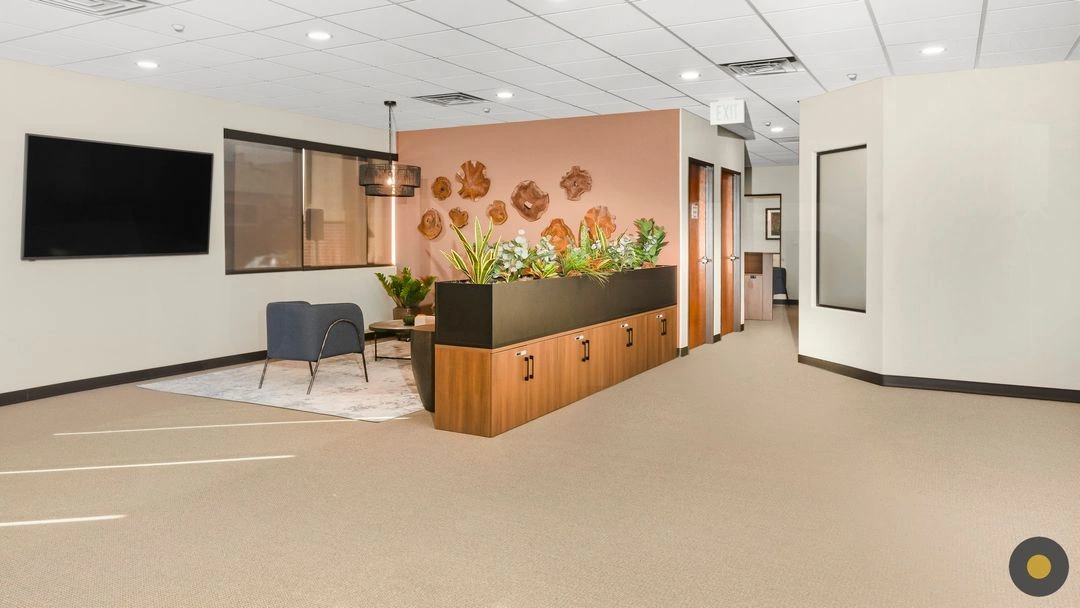
[Robin Pasley]: One of the things I run into is clients who are nervous about putting plant life in a public space — whether it's kids interacting with real plants and soil, or just the maintenance involved. But here's what's interesting: because it's a psychological response, it doesn't matter if they're real or not.
[Randi Lynn Johnson]: I did want to ask you that specifically. Because yes, real plants clean the air, but you can use faux — and we've come such a long way with artificial plants.
[Robin Pasley]: Absolutely. There are some really great faux options now, and yes, they cost more upfront, but you buy them once. And here's the 411: it doesn't matter if your plant is real or faux — you're going to have to dust it either way. I have these big, beautiful birds of paradise plants here in our studio with huge leaves, and they're dusty all the time. So if you don't want to maintain a watering schedule or keep a service, faux plant life is a great option.
[Randi Lynn Johnson]: You mentioned a little bit about how you've used biophilia in your designs.
[Robin Pasley]: It doesn't have to be just a plant in a pot. There are living wall systems now that can be real or faux — another great way to bring nature in. Even the appearance of water works. There are also patterns and materials that reference wood textures and water that support that psychological effect. Part of the work is simply breaking up the static, man-made lines of a built environment with something organic and natural — something that signals to our brain that this is real life. That's what sets us at ease. Studies have even shown that biophilic environments reduce anger and fear. The more we can engage nature in our interior design services, the better it is for us as human beings.
*Recorded in our studio at 616 N. Tejon St., Colorado Springs, Colorado, 80903
PASLEY COMMERCIAL INTERIORS is Colorado's trusted partner for growth-focused commercial interior design. As a woman-owned, NCIDQ-certified firm based in Colorado Springs, we blend spatial branding, client experience design, and turnkey interior solutions that help businesses make powerful first impressions and win their ideal clients. Our direct-to-manufacturer dealership simplifies the commercial furniture procurement process — reducing costs, cutting lead times, and delivering measurable ROI for every client. With deep expertise in workspace strategy, branded environment design, and commercial space planning, we transform business identities into client-converting spaces that inspire loyalty and drive revenue. From boutique and medical aesthetics buildouts to hospitality, multi-family, and franchise commercial projects, PASLEY COMMERCIAL INTERIORS delivers both impactful aesthetics and bottom-line results — because your space should work as hard as you do.
H.B. Pasley, Branding & Business Growth Advisor
616 N Tejon St
Colorado Springs, CO 80903
To request our complete Press Kit, call or schedule a conversation via our Contact Page.



.avif)
